
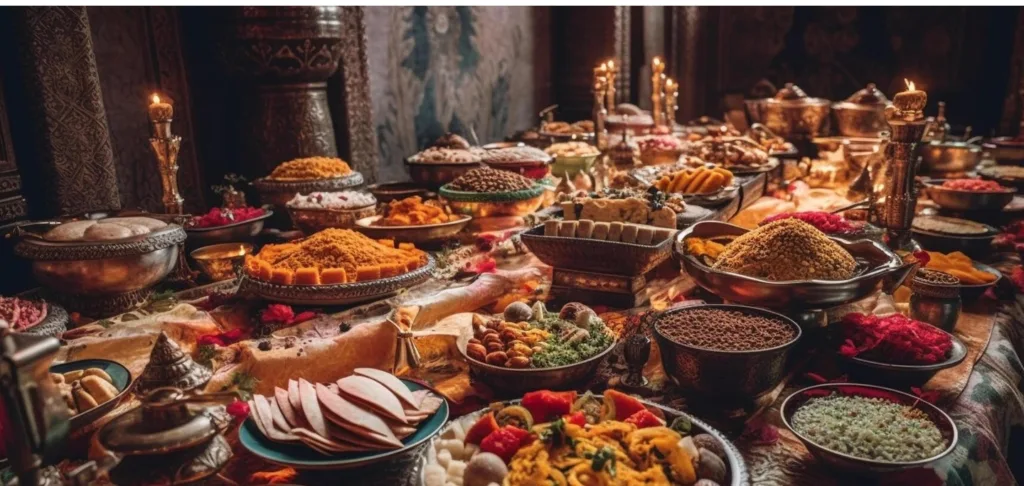
The caterers in Mathura that suit a wedding are the ones who cook a fully vegetarian menu well, can run a separate sattvik or Jain line, and hold a valid FSSAI licence you can check online. Shortlist through a tasting, look at the kitchen and service team, and put quantities, staff, hygiene and guest-count changes in writing before you pay an advance.
We do not name or rank individual caterers here, or quote rates, because both change by season and menu. Instead, this guide shows you how to compare them.
Types of caterers in Mathura and Vrindavan
In-house banquet catering
Many banquet halls, hotels and wedding lawns in Mathura and Vrindavan run their own kitchen and sell food per plate with the venue. One party is responsible for hall, kitchen and service, which is simple to manage. The trade-off is choice: some venues allow only their in-house kitchen or a short approved list, so ask before you sign the venue.
Outside caterers
Independent catering services in Mathura cook at their base kitchen or in a temporary kitchen at the venue, and bring their own counters, crockery and staff. They suit lawns, farmhouses and home functions and give you more menu control. Check whether the venue charges a fee for outside caterers and who provides water, power and a cooking area.
Traditional halwais
Braj has a strong halwai tradition for sweets, kachori, poori-sabzi and large-batch cooking for bhandaras. A halwai team suits a morning-after breakfast, a puja lunch or a mithai counter, often alongside a main caterer for the buffet.
Sattvik and Jain specialists
Some caterers in Mathura and Vrindavan specialise in no-onion-garlic sattvik food or Jain menus. If a large part of your guest list follows these diets, a specialist can either run the whole event or a separate line next to the main buffet. Ask how they keep that line separate in the kitchen, with its own utensils and cooks, not only on a different counter.
What “best caterers in Mathura” should actually mean
The best caterers in Mathura for your wedding are not the ones with the biggest menu card. Judge them on five things: how the food tastes at a tasting of your actual menu, how clean the kitchen and staff are, whether their FSSAI licence is valid and in their own name, how many trained service staff they send, and how clearly they put everything in writing.
Tasting
- Ask for the exact dishes on your planned menu, not their standard sampler.
- Bring two or three family members, including one elder, and taste sattvik and Jain versions separately.
- Look at the crockery, chafing dishes and how food is plated.
- Write down changes the same day and get them reflected in the revised quote.
Hygiene
- Ask where food will be cooked: at their kitchen, at the venue, or both. Visit the base kitchen if you can.
- Check that staff wear caps, gloves and clean uniforms.
- Confirm the water source for cooking and drinking.
- Ask how cooked food and dairy are kept safe during long functions.
FSSAI registration and licence
Every food business in India has to be registered or licensed with the Food Safety and Standards Authority of India (FSSAI). On FSSAI’s eligibility chart updated in April 2026, caterers, described as businesses preparing and serving food for a group at a ceremony or celebration, fall under a State Licence, or a Central Licence for very large turnover, with no basic registration tier. Banquet halls with their own catering can hold a basic registration if they are small, and need a State Licence above the turnover limit.
To check a licence, ask for the 14-digit FSSAI number, open the FSSAI FoSCoS portal at https://foscos.fssai.gov.in/ and use the FBO search option. The result shows the business name, address, licence type, validity and status. Make sure the name matches the business you are signing with, that the licence is current, and that it is a licence rather than a basic registration if you are hiring an outside caterer.
Menu planning for each function
| Function | Menu style | Notes |
|---|---|---|
| Haldi or mehendi | Brunch or high tea, chaat, lassi | Finger food for guests with mehendi on their hands |
| Sangeet | Live counters and a moderate buffet | Keep food going while people dance |
| Wedding | Full buffet, desserts, live counters | Separate sattvik and Jain line; serve elders seated |
| Morning after | Kachori, poori-sabzi, jalebi, tea | Quick and simple before departures |
Most families pair a North Indian vegetarian spread with one or two regional counters, such as South Indian or Rajasthani dal-baati. Many Jain guests avoid root vegetables such as potato, onion, garlic and carrot, and some prefer to eat before sunset, so time and label the Jain counter accordingly.
Braj specialities worth including
- Kachori and aloo sabzi: a Braj breakfast favourite for the haldi brunch or the morning after.
- Jalebi with rabri: a hot counter that works well on cold winter evenings.
- Mathura peda: the city’s best-known sweet, for dessert trays and return gifts.
- Makhan mishri: a small, symbolic sweet that many Braj families like to offer.
- Lassi and thandai: served in kulhads at day functions.
- Chaat: aloo tikki, papdi chaat and golgappe for the evening.
Quantities without waste
Running short and throwing food away are both common at Indian weddings. Rather than relying on a rule of thumb, ask each caterer to show how they calculate:
- How many items per course, and the portion per guest they plan for each.
- How they adjust for children, elders and young adults in the guest list.
- How many buffer plates they keep, and what you pay for buffer that is not used.
- What happens to leftover food; some families arrange for it to go to a local charity or temple kitchen, so agree on packing in advance.
Give a final guest count a few days before each function, and agree in the contract how much the number can move and at what cost.
Live counters
Live counters keep food hot and a sangeet lively, but each needs space, a gas or power point and its own cook. Pick three or four that suit the season: jalebi-rabri, chaat, dosa, tandoori breads or soup in December and January, kulfi or lassi in warmer months. Place them away from the stage speakers and main walkway so queues do not block guests.
Want a caterer shortlist matched to your menu, venue and guest list? Send us your function list and Dreambell Events will suggest caterers who fit.
Venue rules in the pilgrimage area
The Uttar Pradesh government declared 22 wards of the Mathura-Vrindavan Municipal Corporation a pilgrimage site in 2021, and the sale of meat, eggs and liquor is restricted in those wards. Most wedding families here plan a vegetarian, alcohol-free menu anyway. Venues outside those wards set their own policies, so ask the venue to confirm in writing what food and drinks it allows, whether outside caterers are permitted, and any kitchen or cleaning charges.
Questions to ask wedding caterers in Mathura
- Which weddings have you catered in Mathura or Vrindavan recently, and at which venues?
- Can you run separate sattvik and Jain lines with separate utensils and cooks?
- What is included in the per-plate rate: crockery, staff, counters, water, tea and coffee?
- How many service staff will you send for our guest count, and in what uniform?
- What is your FSSAI licence number, and is it in the same name as the invoice?
- What are your payment stages and cancellation terms?
- Who is the on-site manager, and will they stay till the last guest has eaten?
- How do you handle extra guests, a power cut or a sudden change in weather?
Red flags
- No tasting, or a tasting of dishes that are not on your menu.
- An FSSAI number that does not show on the portal, has expired, or belongs to another business.
- A per-plate quote with no written list of what it includes.
- No named on-site manager, or a manager who also has another event that day.
- Pressure to pay a large advance before a contract is signed.
Timeline: what to decide first
- 6 months before: confirm the venue’s catering rules and shortlist caterers.
- 4 to 5 months: hold tastings, check FSSAI licences and sign with one caterer.
- 2 months: fix menus for each function and the number of live counters.
- 1 month: finalise dietary lists, labels and service style.
- 1 week: confirm guest counts, serving times and the on-site manager.
How Dreambell Events manages caterers
Dreambell Events works from Mathura, and coordinating caterers is part of our hospitality and management service. We shortlist caterers who fit your venue, menu and diets, sit in on tastings, check FSSAI details on the portal, and keep menus, guest counts and serving times in line with the wedding plan. On the day, our team works with the caterer’s manager so food is ready for each function.
See how we plan weddings in the city on our Mathura wedding planner page, read the Mathura wedding planning guide, or meet our Vrindavan team if you are looking at caterers in Vrindavan. When you are ready to compare caterers, email hi@dreambellevents.com or ask us for a caterer shortlist.
Frequently asked questions
Do caterers in Mathura serve non-vegetarian food?
Plan for a vegetarian menu. The sale of meat, eggs and liquor is restricted in 22 pilgrimage wards of Mathura-Vrindavan, and most local caterers and wedding venues focus on vegetarian food. If your venue is outside those wards, ask the venue to confirm in writing what it allows on its premises.
How do I check a caterer’s FSSAI licence online?
Ask for the caterer’s 14-digit FSSAI number and enter it in the FBO search on the FoSCoS portal at foscos.fssai.gov.in. The result shows the business name, address, licence type, validity and status. Check that the name matches your contract and that the licence has not expired.
Are caterers in Vrindavan different from caterers in Mathura?
Not much; many caterers work in both towns, which are about 12 to 15 km apart. Vrindavan weddings more often ask for sattvik food and simpler menus near the temples, so check that your caterer has a separate no-onion-garlic line and knows the venue’s kitchen rules.
How early should we book a wedding caterer in Mathura?
Start shortlisting about six months before the wedding and sign after tastings, around four to five months out. Caterers get booked quickly for November to February dates, especially on auspicious muhurat days when many weddings take place in Mathura and Vrindavan at once.
What is a sattvik wedding menu?
A sattvik menu is vegetarian food cooked without onion and garlic, usually lighter on spice and often made with ghee. Many Braj families prefer it for religious functions. Ask your caterer to cook it in separate utensils and to label it clearly at the buffet.